

University faculty and organizational leaders evaluate the structure and state of the energy sector and discuss pressing challenges
Climate Week blog posts were written by students from the University of Michigan. They have not been edited by the U-M Communications team.
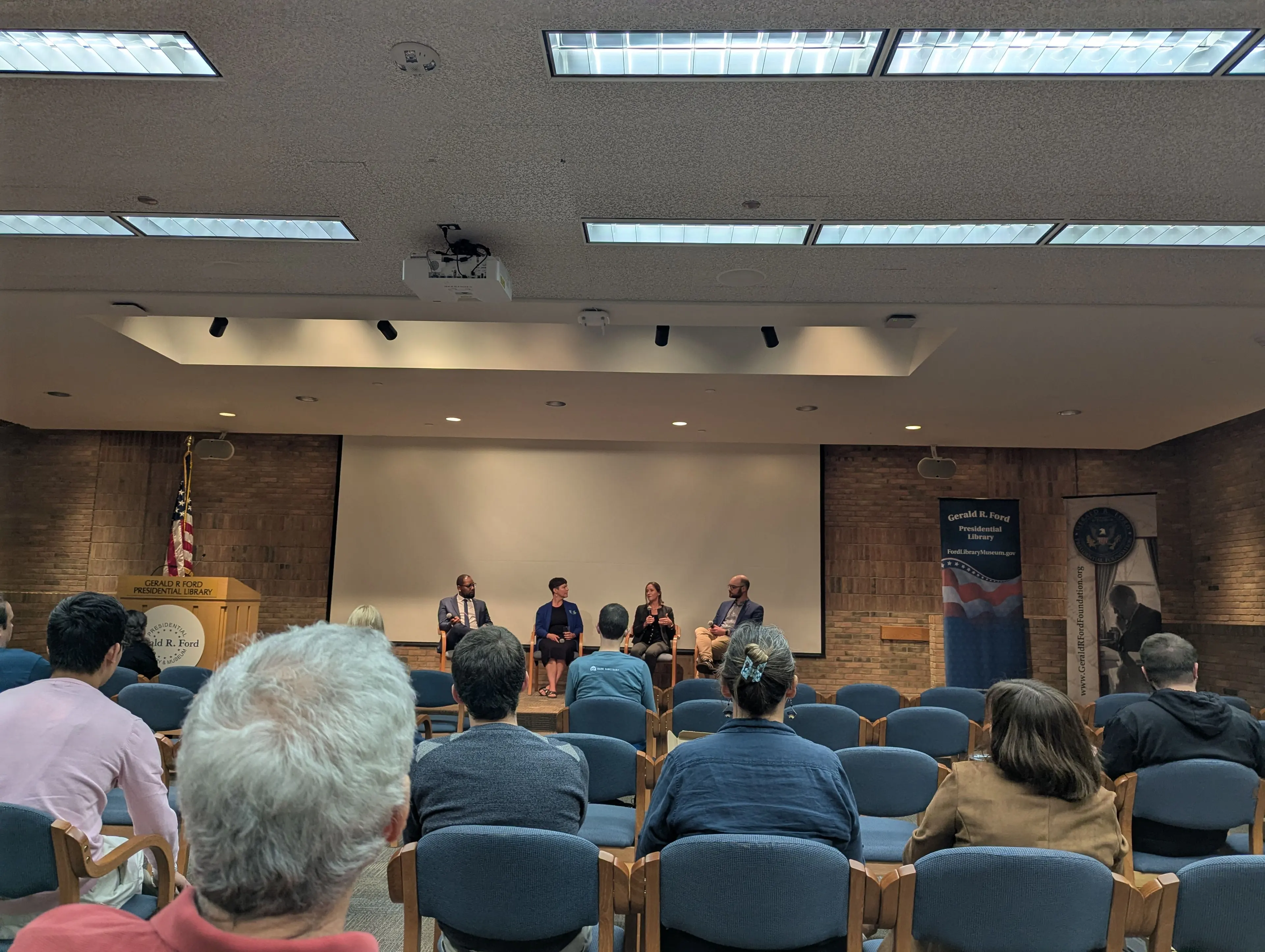
Attendees at the Energy 101 and Electric Utilities panel were introduced to a variety of knowledgeable and accomplished individuals within academia as well as the private and non-profit sectors. The educational session, followed by an industry panel discussion, were all part of the University of Michigan’s first ever Climate Week held from September 27 to October 5, 2025. This specific event took place on September 30 at the Gerald R. Ford Library and was made possible by The Institute for Energy Solutions, School for Environment and Sustainability, and Office of the Vice Provost of Sustainability and Climate Action.
All individuals share a passion for increasing our utilization of renewable energy and addressing societal issues including rising energy costs, continued reliance on energy sources linked to greenhouse gas emissions, and unequal accessibility to clean and affordable energy. The event began with an “Energy 101” crash course facilitated by three faculty members at differing schools within the university.
“Energy 101” Overview
Dr. Johanna Mathieu is an Associate Professor of Electrical Engineering and Computer Science at The University of Michigan’s College of Engineering. She educated the event attendees on how the electricity grid system functions with a focus on incorporation of renewable resources such as wind and solar energy. One of the largest challenges to operating the grid involves being able to accurately forecast energy demand on any given day and supplying energy in a manner that complements this variability. In states such as California, which have adopted solar energy as a large share of their energy supply, the challenges are compounded by the variability of solar photovoltaic (PV) power throughout the day. During the working hours when the sun is shining, an abundance of energy is retrieved, sometimes exceeding demand. However, during the evening hours when individuals are returning home and using more power, the demand exceeds the power generation, creating what is known as a “duck curve”. Dr. Mathieu’s research involves studying distributed energy resources (DER), which include small-scale mediums of energy storage located near places of energy consumption. DERs like solar rooftop PVs and fuel cells can help store out the excess solar energy generated during the day to later distribute during the evening hours when solar power is not being actively generated.
Having acquired a bit of a background behind the infrastructure of the energy grid, Dr. Catherine H. Hausman, Associate Professor of Public Policy at The University of Michigan’s Gerald R. Ford School of Public Policy, walked the attendees through the economics of operating the grid, introducing how the electricity market interacts with its regulatory environment. The electricity grid has massive upfront infrastructural costs (traditionally known as “fixed costs”), leading to what is known as a natural monopoly. Unlike traditional markets where more suppliers often equate to greater efficiency and competitive prices, the presence of several utility companies in a given area is not the lowest cost option. As a counterbalance to the government permitting natural monopolies, private utility companies are subject to regulations with respect to pricing and return on investment through state-level public utility commissions. When we pay our monthly electricity bills, we are not just paying for the cost of producing and transmitting energy to our homes (known as variable costs). A part of our bill is paying for previous infrastructure builds like a power plant that was initially funded by investors. The challenge faced by a public service commission involves defining what a reasonable rate of return is, with some individuals finding this amount to be too high in light of electricity bills increasing by more than the rate of inflation.
The nature of the regulatory environment was further explored by Dr. Alexandra B. Klass, James G. Degnan Professor of Law at Michigan Law. An established professional within energy law, environmental law, and natural resources law, Dr. Klauss joined Michigan Law faculty after having served for the Biden-Harris administration as well as the US Department of Energy. She built upon the information Dr. Mathieu and Dr. Hausman provided by introducing two more types of electric utility companies besides investor-owned ones- public power utilities and rural electric cooperatives. While we have fewer investor-owned utilities compared to public and rural ones, investor-owned utilities (IOUs) serve the greatest number of customers. The federal and state government do not heavily regulate public power utilities and rural electric cooperatives, as they are not for-profit institutions. Several communities have found benefits in municipalization, or the transfer of utilities from for-profit entities over to the municipality. Within Michigan, cities including Lansing and Traverse City have successfully municipalized. While offering the benefit of reinvestment of excess funds back to the community, such initiatives are challenged by high litigation costs and extended timelines. A potential alternative to municipalization is the formation of a Community Choice Aggregation (CCA), where the municipality purchases all power for its residents and businesses, often being able to secure lower rates and selection of greener energy sources.
Electric Utilities Panel
After a power hour of learning, the attendees were provided with a boxed lunch (provided by the Produce Station in Ann Arbor) in preparation for the industry panel. The panel was moderated by Dr. Tony G. Reames, Tishman Professor of Environmental Justice at The University of Michigan’s School for Environment and Sustainability (SEAS). He is also the Director of the SEAS Detroit Sustainability Clinic. He was joined by three leaders who are each actively working to enhance and improve our energy utilities infrastructure. Maggie Striz Calnin is the Corporate Sustainability Administrator for Lansing Board of Water & Light, a public utility company providing both water and electricity to the Lansing area. Aaron Willis is a Director of Regulatory Affairs at DTE Energy, an investor-owned utility operating out of Detroit serving electricity to around 2.3 million customers in Southeastern Michigan. Shoshannah Lenski is the inaugural Executive Director of the Sustainability Energy Utility of Ann Arbor, a newly launched community-owned utility providing a supplemental source of renewable energy to Ann Arbor residents, which was established after Proposal A on the November 2024 election ballot successfully passed.
The panelists introduced themselves by explaining how they found themselves working within the energy sector. Maggie has background working both within government and nonprofit, with some of her earlier work focusing on developing and maintaining clean energy projects to move the tide away from petroleum dependence. She began her most recent role at Lansing Board of Water & Light just this past April. Meanwhile, Shoshannah was motivated to work within the energy sector given the fundamental importance of energy in all our lives, while also realizing the existing inequality in its accessibility. Prior to joining the newly launched Sustainability Energy Utility, she worked within management consulting, graduated from SEAS with an MS in Sustainable Systems, and later returned to the university as Associate Director in the Center for Sustainable Systems. Turning the microphone over to Aaron, his initial motivation was to focus on water, publishing a review of the water sector within Mali while working with the U.S. Army Corps of Engineers and United States Agency for International Development. However, he became more involved with energy after pursuing a graduate degree at the Yale School for the Environment. Dr. Reames found commonalities in all their backstories, as it was all rooted in the power “to want to do something”.
When Dr. Reames asked each panelist about a challenge in their role and how they are thinking about addressing it, Shoshannah highlighted the high upfront costs of transitioning to cleaner energy sources on an individual level, even if the return on investment is priceless. For example, most households cannot afford to spend $40,000 upfront to install solar panels, barring those that want to make a positive change from doing so. Ann Arbor’s Sustainability Energy Utility (SEU) is looking to address this by splitting the costs of solar panels amongst their customer base with financing at an interest rate that is lower than those associated with investor-owned utilities. In this way, substantial infrastructure changes can occur on the individual household level. Ann Arbor residents are able to express interest in enrolling in the SEU by visiting a2gov.org/a2seu.
Maggie expressed concerns about individuals holding themselves separate from the planet or viewing the actions they do to be too small to make an impact. With respect to rising energy costs, she highlighted the increased vulnerability of those living paycheck to paycheck from having their utilities repeatedly shut off. Imposing large fees for restoring shut down utilities also acts as a barrier for individuals to be able to reliably pay their bills each month. She emphasized the need for programs and resources to help those struggling to pay their utility bills.
Aaron highlighted some of the work DTE has done on this front, including holding customer resource fairs to educate about energy efficiency as well as enrolling individuals in a Low-Income Self-Sufficiency Plan, which prevents those enrolled from utility shutdowns as well as late payment charges. When Dr. Reames asked what a good call to action would be for everyone in the room, Aaron advocated each individual to find a specific area in which you think you would bring the most value. Even if you do not have an extensive background in that domain, what matters most is that you care about that particular cause, and that alone can drive positive change.
The event concluded with an announcement from Liesl Eichler Clark, Director of Climate Action Engagement at SEAS. She highlighted a new grant associated with Research Universities for Michigan (RU4M), a partnership between The University of Michigan, Michigan State University, Michigan Technological University, and Wayne State University. The Livable Futures – Water Collaboration Grants initiative is a collection of grant funds totaling $400,000 to support research on pressing water issues including precipitation pattern changes and increased severity of flooding. More information can be found on miresearchuniversities.org, with grant proposals due by December 1, 2025.