

U-M Climate Week Kickoff Event
Climate Week blog posts were written by students from the University of Michigan. They have not been edited by the U-M Communications team.
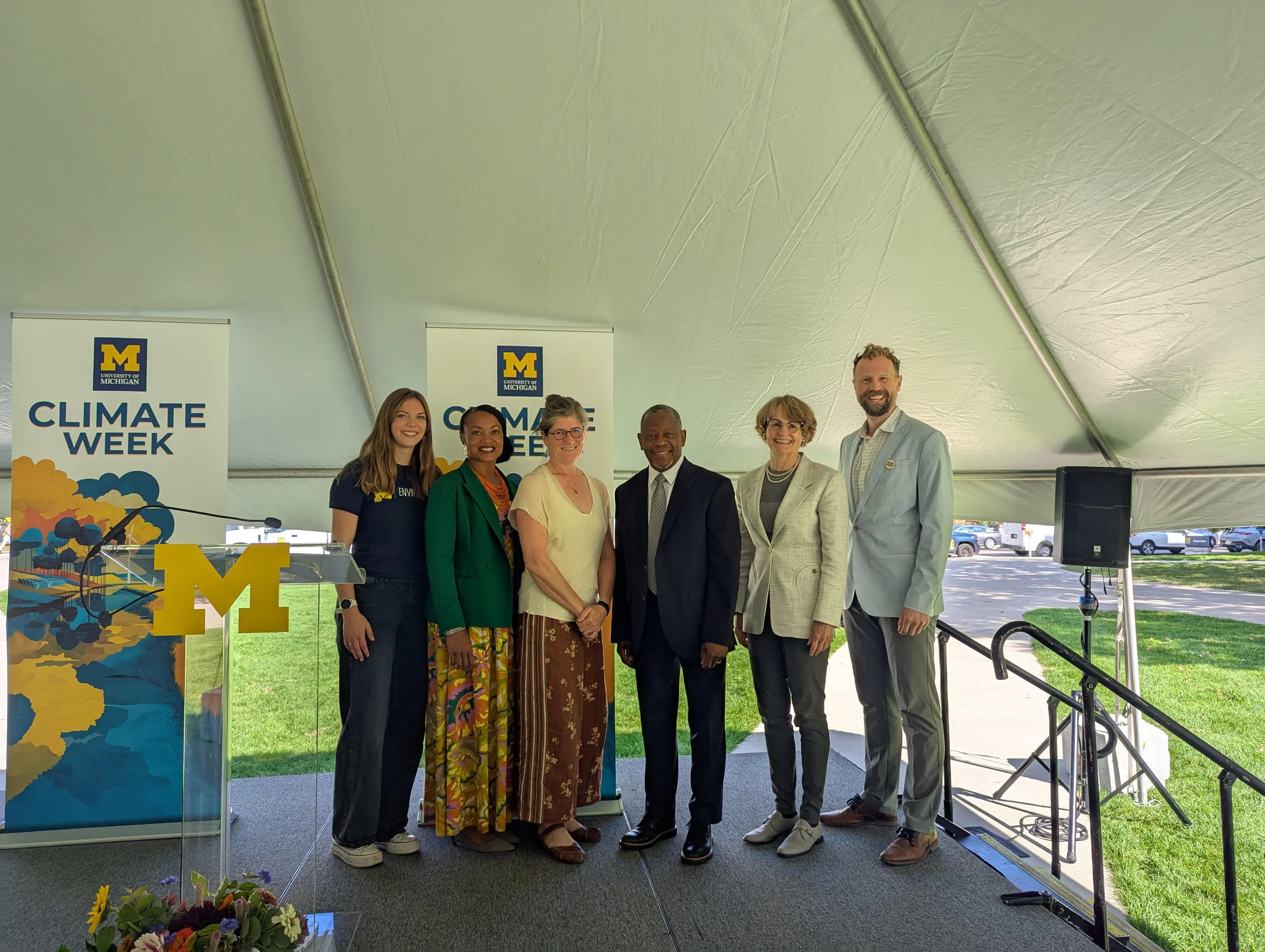
Monday, September 29, officially kicked off the University of Michigan’s first annual Climate Week on Ingalls Mall, with U-M’s Fanfare Band and speakers from the Sustainability and Climate Executive Leadership Council, the Director of Student Life Sustainability, the Provost and Executive Vice President for Academic Affairs, Ann Arbor’s Sustainability and Innovations Director, and the 2025 Raoul Wallenberg Fellow.
Following a warm welcome from Michigan’s Fanfare Band, Laurie McCauley, U-M’s Provost and Executive Vice President for Academic Affairs, began by highlighting the university’s ambitious climate work and its goal of developing innovative solutions and driving meaningful climate actions to shape a healthier world.
The Sustainability and Climate Executive Leadership Council, the first cross-council leadership of its kind in a public university, is driving efforts across all sectors to transform U-M into a living laboratory. The council, with Shalanda Baker, Shana Weber, and Tony Denton, brought hope and inspiration to the attendees.
“This is our inaugural Climate week, so give yourselves a round of applause,” Baker said to the crowd. In her speech, Baker, the inaugural Vice Provost for Sustainability and Climate Action, discussed what brought her into the sustainability field. She saw her own community being affected by environmental pollution in Port Arthur, Texas, with no access to the thriving community around them. While experiencing a rich academic and professional career, including in the U.S. Department of Energy, Northeastern University, and the Initiative for Energy Justice, she saw the power of students during her time working on the clean energy transition in Hawaii.
“You are truly amazing, and you inspire me every single day. You bring fresh ideas and creativity to the classroom and push us to do better. You, students, are the leaders our world so desperately needs right now,” she said to the students in the crowd.
Baker announced the launch of the Michigan Community Climate Action Fellowship (M-CCAF), a pathway for climate leadership to transform state and higher education across the country for U-M students in Ann Arbor, Dearborn, and Flint. “You are the catalysts, you will continue to inspire us.”
Tony Denton, the Senior Vice President and Chief Environmental, Social and Governance Officer for Michigan Medicine, emphasized the interconnected nature of health and environment, highlighting the greatest health threat to our society: climate change. He shared the steps Michigan Medicine has taken to improve their environmental footprint, looking at the actions to reduce greenhouse gas emissions, eliminate harmful chemicals, increase the purchase of healthy sustainable food, and handle waste properly.
Denton was proud to announce that final touches are in place for the largest LEED Platinum certified healthcare facility in North America, a 700,000 patient facility designed for the care of complex patients for years to come. The construction–-from water and energy efficiency to material selection—was all in mind to support Michigan Medicine’s sustainability goals for world-class care.
Denton then introduced Shana Weber, Associate Vice President for Campus Sustainability, who highlighted the role of students on Michigan’s campuses, and the Maize Rays initiative, the largest campus solar installation in higher education, which, combined with off-campus solar farms, will allow all electricity purchased by the university to be net carbon zero by 2027.
“This is a place where curiosities manifest,” Weber said.
To honor the contributions that brought everyone together for this first climate week, the Council is planting a birch tree, announced Weber, symbolizing the formation of the roots, and how the stronger the roots are, the higher it reaches.
Missy Stults, Sustainability and Innovations Director for the City of Ann Arbor, encouraged individual action. “All of us together are stronger,” she said. “Look in the mirror, put on your cape, and let's get to work.”
She shared an interesting anecdote–-that there is no point where a system is more resistant to change than when it is about to snap, and explained that concept through the use of a rubber band. The harder it was to pull, the closer it was to breaking. Stults says this moment in time might be hard on climate action just because it’s about to spark the change our climate needs.
“Maintining hope requires that we take action, that we tell people about our work, but even more, that we listen. This movement is going to need all of us,” Stults said.
Finally, Stephanie Smith, the 2025 Raoul Wallenberg Fellow at U-M, took the stage to remind the crowd of the work students are doing. “Our students are leading on climate. That’s for sure,” she said. “We’re tired of hearing the same perspectives of those currently in power.” She explained that climate change is not an issue that the youths of tomorrow have to deal with, but something that is happening now, across generations, as shown in the speakers from the kickoff event.
The event ended with a final song, “The Victors,” with the Fanfare Band. “Join us in this movement, because it’s worth fighting for,” said Stults.