

Multifaceted and interconnected: How sustainability in Michigan Athletics is changing the game
Climate Week blog posts were written by students from the University of Michigan. They have not been edited by the U-M Communications team.
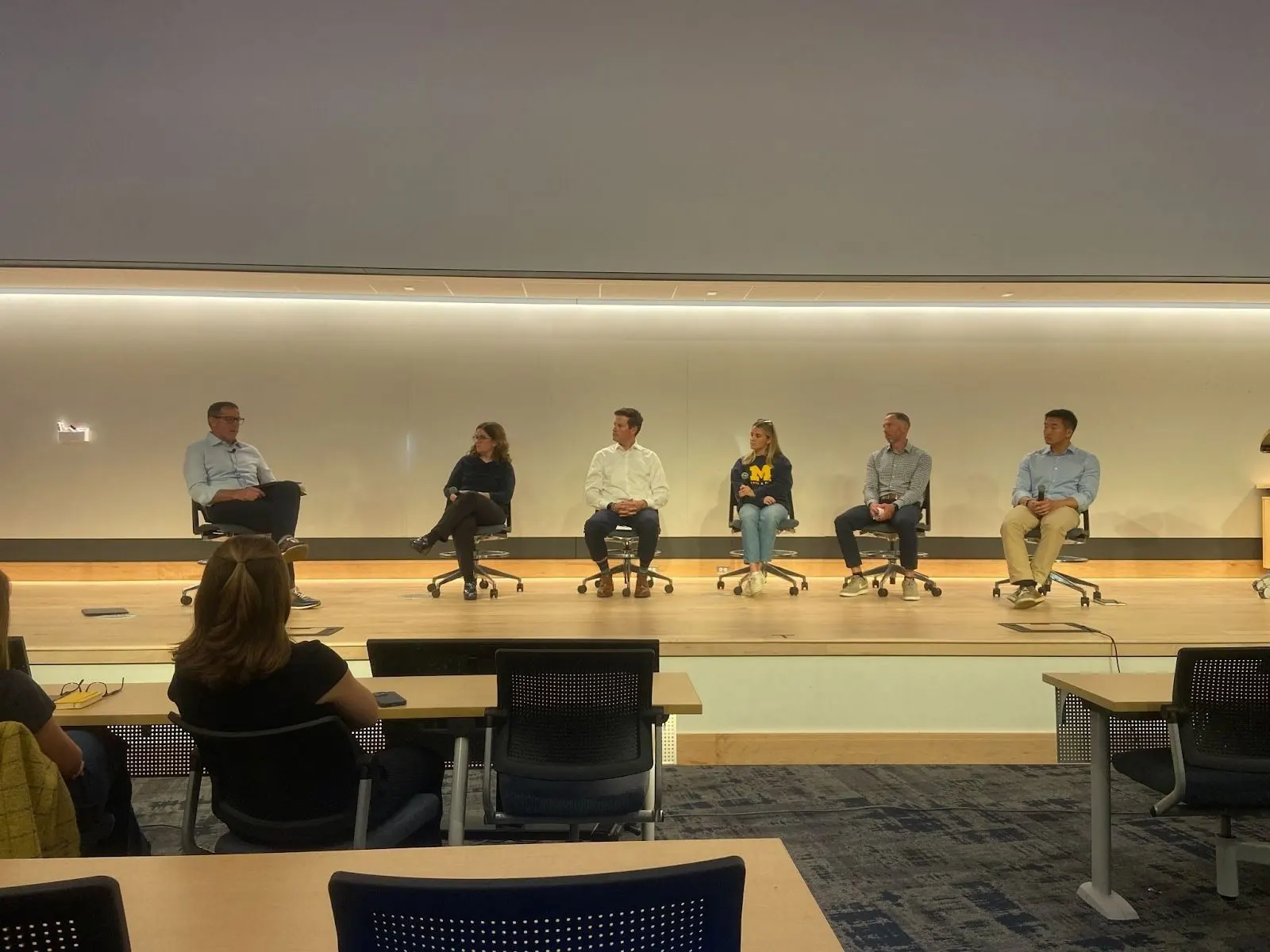
While perhaps not the hallowed grounds of Michigan Stadium, room 1420 in the Central Campus Classroom Building had its own star power on Friday afternoon. On October 3, 2025, the Office of the Vice Provost for Sustainability and Climate Action (OVPSCA), School for Environment and Sustainability (SEAS), Program in the Environment (PitE), and Michigan Athletics combined to sponsor a panel entitled, “From Sidelines to Solutions: Sustainability in Sports,” that was moderated by National Championship-winning quarterback Brian Griese.
Among the panelists were two former Michigan student-athletes, Natalie DeSarbo and C.Y. Cheng, two associate professors, Dr. Sara Soderstrom and Dr. Brian McCullough, and Michigan associate athletic director, Paul Dunlop. Current soccer player Sophie Homan was unable to make an appearance in-person but was able to contribute to the discussion via a pre-recorded video. The panel was a featured part of the University of Michigan’s first-ever Climate Week.
The discussion centered around the “bidirectional relationship,” as Dr. McCullough called it, between the environment and sports. Not only do humans influence the environment via sports, such as through waste generated during tailgates or grass being grown for soccer fields, but the environment influences sports in return. The multitude of examples of sports teams, both professional, collegiate, and amateur, having to shift locations and times of sporting events due to severe weather is reason enough to care about the worsening extremities of weather due to climate change.
A primary theme of the panel, both explicitly and implicitly, was circularity. Dr. Soderstrom explicitly mentioned circularity through the story of waste from Michigan football games, as the compost generated from all home games this season goes to the Campus Farm to support locally grown foods. These foods then circle back to students via dining halls and the Campus Farm Stand on Thursdays.
The implicit side of circularity came from the camaraderie and connections between the panelists. Instead of being a hodge-podge of speakers, numerous panelists had worked together in a variety of capacities. DeSarbo, Cheng, and Homan all were involved in the creation and continued operations of the Student-Athlete Sustainability Club, along with DeSarbo and Cheng working together as researchers of Scope 3 emissions through the Erb Fellows program. Cheng and DeSarbo worked closely with Dr. Soderstrom throughout and after their studies, and Cheng worked with Dunlop on zero-waste initiatives for Michigan Stadium. This aspect of the panel was unique and created an inspiring synergy for the future of sustainability in Michigan Athletics.
According to Courtney Bessell, Michigan Athletics Sustainability Intern and panel attendee, the goal of Michigan Athletics as it pertains to sustainability “is for everyone involved in Michigan Athletics, including our fans, coaches, student-athletes, and staff, to actively support sustainability." Zero waste at Michigan Stadium was touted throughout the panel for its role in this goal via its visibility, effectiveness, and high standards. The first game of the Michigan football season “diverted 79% of waste away from landfills” (Dunlop), in large part thanks to everything sold inside the stadium being recyclable or compostable. However, recognizing the need for continued improvement in sustainability measures, Michigan Athletics aims to increase this figure to 90% while making these efforts even more visible in hopes of inspiring students and fans alike.
Overall, the “Sidelines to Solutions” panel showed the multifaceted and interconnected nature of the growing sustainability community with Michigan Athletics. Moderator Brian Griese concluded the panel by recognizing the historical precedents of sports as a force for good, from Billie Jean King advancing women’s rights to Megan Rapinoe supporting LGBTQIA+ rights. Griese’s challenge, ever pertinent for us all, is for athletes, athletics staff, and fans alike to channel their capacity for stewardship and further integrate sustainability into athletics and beyond.