

Build and power: Abundance debate at U-M Climate Week
Climate Week blog posts were written by students from the University of Michigan. They have not been edited by the U-M Communications team.
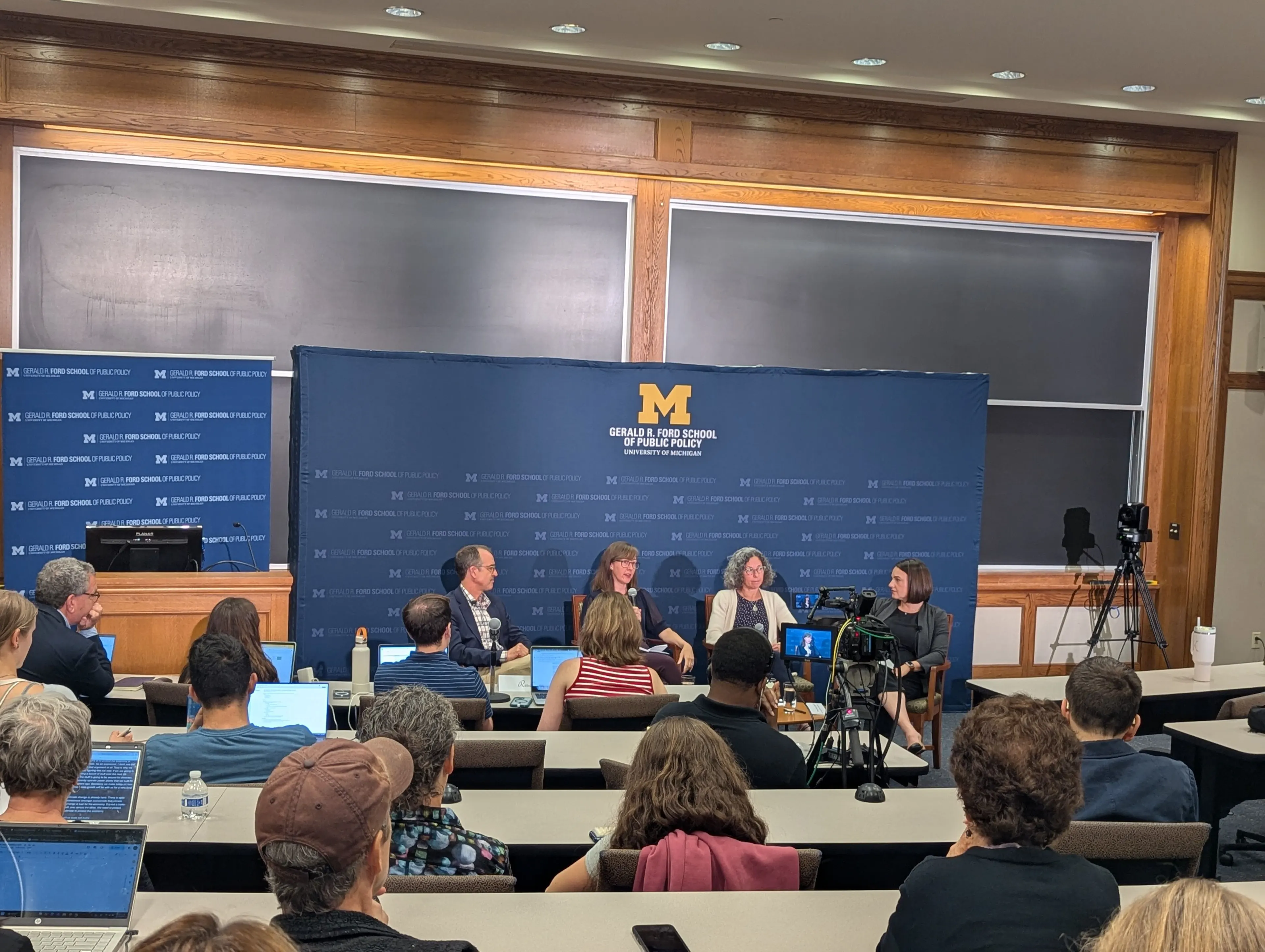
For a long time, building more was considered bad for the environment. However, today, more can be better, including for a reliable and sustainable power system to meet the growing demand. The inaugural U-M Climate Week featured this debate in an abundance panel, “Development and Decarbonization: Competing Energy Futures.” Sponsored by the Ford School of Public Policy, the event brought together energy policy consultant Rob Gramlich, the Ford School’s Catherine Hausman and Kaitlin Raimi, and Law School Professor Alexandra Klass.
U-M Director of Climate Action Engagement Liesl Eichler Clark highlighted the interdisciplinary character of the discussion. “I am really excited about this panel because it brings in Rob Gramlich, who is a nation-leading expert in the energy space and in what we need to do to deploy clean energy. And coupling him with the awesome talent at the Ford School and the University of Michigan Law School, we have some incredible minds to discuss this issue. And this event itself is such a good example of different parts of campus leaning in on Climate Week,” she said.
The event began with a presentation by guest speaker Rob Gramlich, President of Grid Strategies LLC from Washington, D.C., and co-founder of several initiatives, including Americans for a Clean Energy Grid and Working for Advanced Transmission Technologies, among others. Gramlich went through the main challenges of decarbonizing utilities and underscored 3Ps for big transmission, and nuclear energy for long-term sustainable power generation.
Gramlich noted that data centers have become a new challenge that was not on anyone’s agenda until recently. “Nationwide, we are looking at about 16% load growth by the end of the decade. Percentage-wise, it is not bigger than ever in history, but gigawatt capacity-wise, it is unprecedented,” he said. To meet this growing demand, an abundance of energy will be a necessity.
Following the presentation was an expert discussion. The moderator, Dr. Kaitlin Raimi, an associate professor of public policy at the Ford School and a public perceptions scholar, raised the questions about changing and disrupting the utilities sector, accounting for price structure, and developing rules on sustainable infrastructure to meet the growing demand for electricity.
James G. Degnan Professor of Law at Michigan Law Alexandra Klass spoke from the legal perspective and her experience with environmental and energy regulation. She explained how the economics and technology favor the generation of carbon-free electricity (wind, solar, batteries), but regulations and policies challenge the shift from fossil fuels. “We need to expand our transmission grid and we need to build a lot of clean energy, but there are local or state regulations that can stand in the way of that. Presently, we also have federal permitting that is trying to be easier on fossil fuels and much more difficult on renewable energy,” Dr. Klass said.
In the debate, Dr. Klass highlighted Texas as an interesting example of an abundance state. “Texas has no climate policies; they are not into greenhouse reduction. The most wind, the most solar, and the most transmission that has been built in this country is in Texas. It is a good business climate for building anything. They just do less regulation, and they make it easy to build a lot of stuff,” she explained.
Apart from Climate Week, the panel connects to the school-wide abundance debate at the Ford School of Public Policy. This semester, students, faculty, and staff at Ford School are reading the 2025 New York Times bestseller – Abundance, by Ezra Klein and Derek Thompson. The book critiques scarcity thinking, regulatory overcomplexity, and incrementalism, and invites government reform in the politics of plenty. Adding to the discussion, the Ford School also hosts events about the philosophy of abundance in energy, infrastructure, and housing.
Catherine Hausman, an associate professor at the Gerald R. Ford School of Public Policy and a research associate at the National Bureau of Economic Research, added an economist's perspective to the discussion. She highlighted that in contrast to common opinions, decarbonization and economic growth are not in conflict with each other, and carbon-free options in electricity are becoming more cost-effective. There is, however, a current challenge of rising prices, and states need to define who pays what.
“If we figure out regulatory hurdles, I am confident we can do it in a way that is economically viable,” Dr. Hausman concluded on sustainably meeting growing demand for electricity.
The panel drew the attention of U-M students and faculty, industry members, and Ann Arbor residents. Megan Jones, a PhD student at the Schools for Environment and Sustainability and Electrical and Computer Engineering, does grid research with Dr. Michael Craig and attended the event for her project goals. “I am interested in hearing perspectives outside of the engineering space. This panel is much more focused on law and economics, which is a side of energy research that I do not know a bunch about, but I think it is important to understand,” she commented.
Discussions about power and energy can be overwhelming. The U-M panel invited the audience to rethink development and decarbonization through the lens of abundance, and shared the current challenges of power markets and advancing solutions. The key message is clear: “The status quo favors fossil fuels. The only way to phase out fossil fuels is to build a lot of carbon-free generation,” Dr. Klass said.
Watch the full talk below.