

Artistic approaches to an environmentally just world: where creative practice lives within Climate Week
Climate Week blog posts were written by students from the University of Michigan. They have not been edited by the U-M Communications team.
Artistic Approaches to an Environmentally Just World was a panel discussion on how arts research and creative practice matters and lives within Climate Week. The panel was moderated by Clare Croft, professor in the Department of American Culture, and composed of artists and scholars from a variety of disciplines who drew connections between art and sustainability through their various unique careers.
Material life cycles was a common theme for panelists. For example, Shawn Rieschl Johnson is the chief programming and production officer at the Detroit Opera. As a facilitator of the creative process, his role is seeking sustainable solutions to those challenges that block the creative process, such as financial constraints and labor relations. One of his ongoing objectives is reducing the Opera’s long-term storage sustainably and rehousing those materials.
Sarah Oliver is an associate professor of theater and drama at the University of Michigan. Inspired by her mother’s quilting, she found sustainability through textiles and implements sustainable practices in costume design. She described the process by which artists can consider the life cycle of the material and create works by translating textiles into new life in collaboration with the previous artist. Joseph Trumpey, professor in the Stamps School of Art and Design, also described the importance of life cycle analysis in design. He approaches art in an environmentally just world from a sense of place, rooted in his experiences as a Boy Scout. He recalled his experiences observing the vast dichotomy between the oil refineries around Indianapolis and the nearby Hoosier National Forest. The contrast of space and place he observed is connected to how he incorporates material sourcing and circular economies into his courses. For example, one of his courses required students to befriend a tree, encouraging students to honor the living things that provide our materials.
Jen Maigret, professor of architecture in the Taubman College of Architecture and Urban Planning, practices art through architectural design. She started her career as a restoration ecologist and transitioned to architecture to determine how to work on the built environment in a way that moves away from extractive practices.
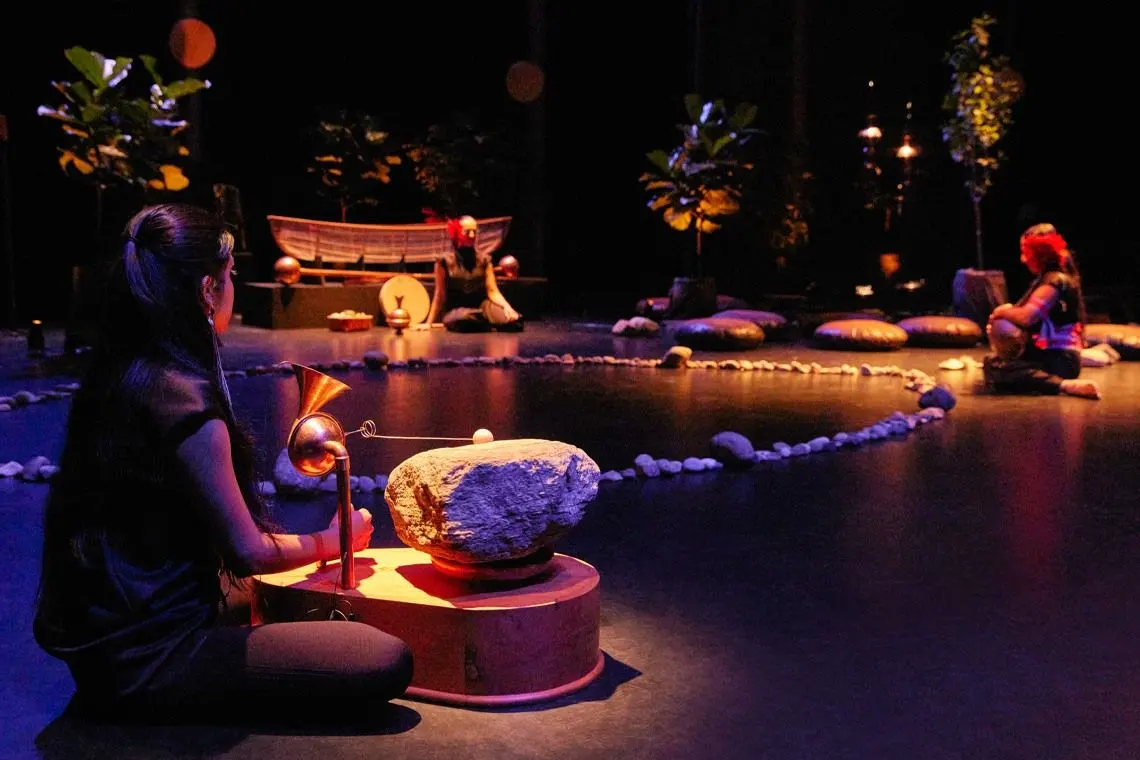
The panel also included artists with local impacts. Alexis Lamb, founder of the Refugia Festival, which recently took place at Matthaei Botanical Gardens and Nichols Arboretum, advocates for conservation through sound, and discussed not only her experiences with Refugia, but her thesis work on sound and place. Lamb described her experiences in performing percussion in remote spaces and respecting her role as an artist in unique soundscapes. The panel was rounded out by Émilie Monnet and Waira Nina, the artists behind Nigamon / Tunai. In this performance, Nina, from the Inga nation of the Caquetá region of the Colombian Amazon, and Monnet, of Anishinaabe and French descent, invite the audience to consider the relationships between the people and land around them and give voice to Indigenous knowledge. Monnet invited viewers to consider what cycles we are caught up in and how we can move away from activism and toward reciprocity with nature. These considerations were mirrored by Nina, who discussed her upbringing as the child of traditional doctors and a steward of local knowledge, as well as practices of academic extractivism from Indigenous knowledge in the region.
This insightful panel highlighted the important work being done in Michigan and beyond towards environmental justice through art at the nexus of scholarship, design, and creativity. The event was a call to action, encouraging attendees to consider art and creation in a sustainable and environmentally just manner.